News
Osmosis water and minerals: what’s the story?

Start reading about reverse osmosis and sooner or later you'll come across this objection. The membrane holds back dissolved substances, and minerals such as calcium and magnesium are dissolved substances. So they go too.
That's true. It isn't a marketing problem we need to gloss over — it's simply how the technology works. The question is what it means.
Where minerals come from
A common assumption is that drinking water is an important source of minerals. In practice, the vast majority of your calcium, magnesium and potassium comes from food: dairy, vegetables, nuts, pulses and wholegrain products.
On top of that, the amount of minerals in tap water varies widely by region. In the Netherlands, hardness ranges from soft in parts of the north to hard in parts of the south and east. So two households that both drink tap water take in very different amounts — without anyone noticing.
That difference is bigger than the difference between tap water and filtered water. Which makes it hard to argue that drinking water is a critical source of minerals.
What we don't know
We have to be honest here: there's no scientific consensus on the long-term effects of drinking demineralised water.
The WHO has published reports on this that point to possible concerns with water that has very low mineral levels, particularly in contexts where water really is a substantial source of minerals. There are also researchers who argue that this is barely relevant for a Western diet.
We're not going to take a side we can't back up. What we can say is this: it's an open question, not a settled one, and anyone who tells you the answer is definitive — in either direction — is going further than the science.
What you can do about it
If it's on your mind, there are practical options.
Look at your diet, not your water. This is the most effective route, and the one mentioned least, because there's nothing to sell. A handful of almonds contains more magnesium than litres of tap water.
Mix your water. Part filtered, part tap water. Not elegant, but it works and it costs nothing.
Use mineral drops. There are products that add minerals to filtered water. We don't sell them and have no stake in them; if you want to go down that route, check exactly what's in them.
Why people filter anyway
The trade-off isn't “minerals or no minerals”. It's: which dissolved substances would you rather not have in your glass, and what price do you pay for that?
An RO membrane isn't selective. It can't hold back one dissolved substance and let another through depending on whether you want it. What goes, goes — all of it.
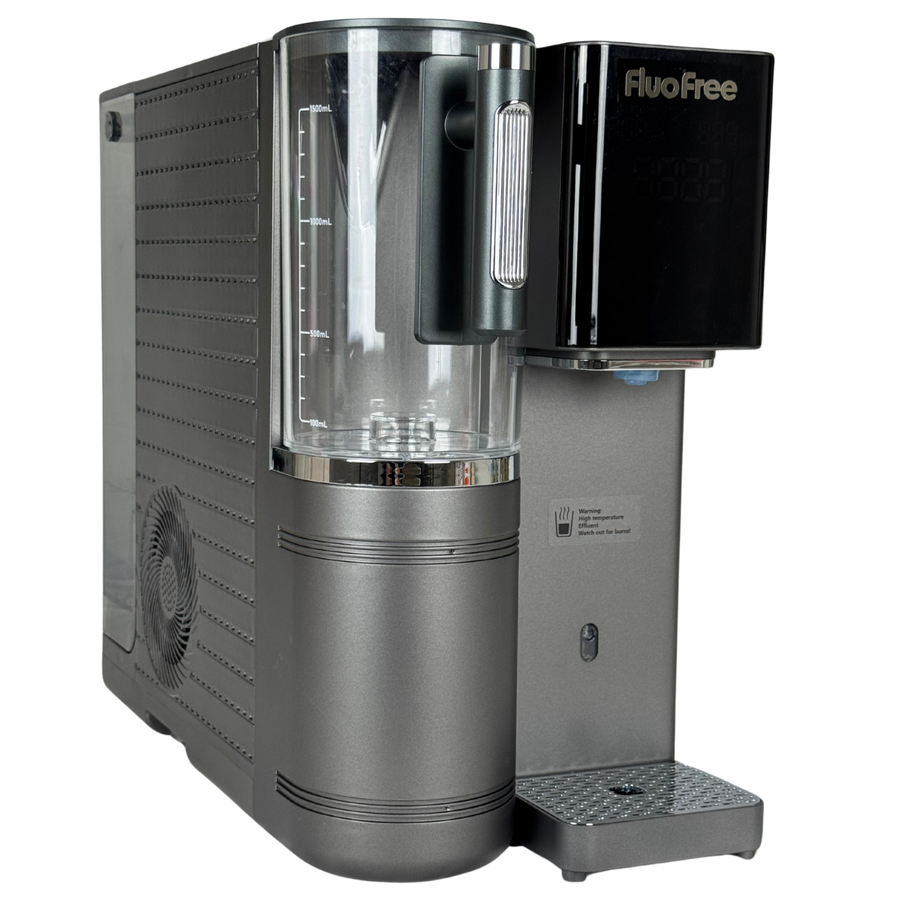
That's why the Osmora Premium remineralises: after the membrane, calcium and magnesium go back into your water. So you get reverse osmosis filtration without stripped water. Read how the remineralisation works or take a look at the Osmora Premium.
That's the honest summary of the choice. For most people who buy from us, the first weighs more heavily than the second, but that's their call — not one we make for them.
What mineral water doesn't solve here
A misconception we often come across: that bottled mineral water supplies the minerals filtered water lacks.
Some brands do contain substantial amounts. But many other bottled waters have a mineral content similar to or lower than tap water. It's on the label, in mg per litre. Have a look — the difference between brands is bigger than most people assume.
Got a question we haven't answered here? Email us at support@fluofree.com. We'd rather give you an honest answer than a salesy one.
Read also: how does reverse osmosis work?